
Please find the program and further details on the 15th annual conference of the Emerging Scholars‘ Forum of the Association for Canadian Studies in German-Speaking Countries here. The conference will take place in Berne, Switzerland, June 29 to July 1, 2018. Also don’t miss the event on the eve of the conference in Bern!
Autor: GKS
Samstag, 23. Juni 2018 ab 15:30 Uhr, Filmmuseum, Schulstraße 4, 40213 Düsseldorf
Die Regionalgruppe der Deutsch-Kanadischen Gesellschaft zeigt im Filmmuseum Düsseldorf den Film Maudie über das Leben der an Arthritis leidenden kanadischen Malerin Maud Lewis, der u.a. als Special Presentation auf dem Toronto Film Festival und auf der Berlinale gezeigt wurde und zahlreiche internationale Auszeichnungen erhalten hat.
 Mit dem Filmmuseum Düsseldorf und seinem ca. 130 Personen fassenden Kinosaal konnte die DKG einen Kanada besonders verbundenen Partner gewinnen: Der Direktor Bernd Desinger ist nicht nur ein langjähriges Mitglied der DKG, sondern hat auch viele Jahre für das Goethe-Institut in Toronto gearbeitet. Das kanadische Konsulat in Düsseldorf hat sich freundlicherweise bereiterklärt, vor der Filmvorführung einen kleinen Empfang mit kanadischen Speisen und Getränken zu sponsern. Da der Film zwar in Nova Scotia spielt, aber in Neufundland gedreht wurde, wird Tourism Nova Scotia die Provinz mit „echten“ Bildern vorstellen.
Bei der zeitlichen Planung das am Abend ab 20 Uhr stattfindende WM-Fußballspiel Deutschland – Schweden berücksichtigt. Wer Interesse hat, kann nach dem Film zum Public Viewing in der Alststadt aufbrechen. Um die Planung zu erleichtern, bittet die DKG um frühzeitige Anmeldung.
Anmeldung: https://bit.ly/2KeUXYR
bis 21. Dezember 2018 am JFKI, FU Berlin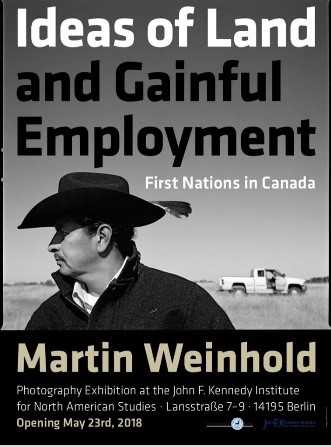
Am John-F-Kennedy Institut für Nordamerikastudien werden Bildern von Kanada des Fotografen Martin Weinhold ausgestellt. Der deutsch-kanadische Fotograf dokumentiert in seinen Aufnahmen seit über 10 Jahren die Lebens- und Arbeitswelten Kanadas einschließlich der First Nations. Die Ausstellung „Ideas of Land and Gainful Employment: First Nations in Canada“ läuft bis zum 21. Dezember. Die Ausstellung ist öffentlich, der Eintritt frei.
Editors: Caroline Rosenthal, Laurenz Volkmann, Uwe Zagratzki
Neighbourly relations frequently position a “self” against an “Other”. This is the case for both individuals and nations, and, indeed, within the various cultural groups of a nation. Our racial, ethnic, social, or gender identities are often created in demarcating ourselves by stereotyping the Other. Disrespect of the immediate neighbour based on stereotypical pre-conceptions and cultural biases may lie dormant for a long time and then, as shown in recent conflicts around the globe, suddenly surface due to changed economic and political conditions.
Media, including films and fictional as well as non-fictional texts, feature prominently in producing, propagating, and maintaining cultural difference and stereotypes in ideologically effective ways. This volume analyses re-presentations from various angles, as it comprises articles dealing with ethnic groups and neighbo(u)rhoods from three world areas, as well as genres and media instrumental to their respective cultural stereotyping. This focus on literary and media representations of the neighbo(u)rly Other from miscellaneous cultural environments results in a comprehensive understanding of analogies and differences in the mechanisms of production and perception of stereotypes. Addressing the manifold discourses at the heart of stereotyping the familiar Other, the book also points to their far-reaching repercussions on lived cultural practices.
International Colloquium – Poitiers University (France), October 15-17 2018
Fifty years have gone by since the protest movements of May and June 1968 in France took place, combining an array of crises (a crisis of the condition of students, a broader social and political crisis) and struggles into a “revolution” which left its mark due to some of its unique features as well as its international potential. Half a century later, however, we propose to reconsider the significance of this period’s movement(s) by de-centering the approach, looking specifically at its trans-American and Caribbean dimensions.
From the perspective of France, the abundant literature which has analyzed these movements tends to place them either as the center of a European wave of “protest” and, depending on the point of view, as a source of disorder or, rather, for progressives notably, as a movement limited to anti-authoritarian aspirations. However one notices that the prevailing interpretations seek to rob this symbolic and crucial year, within the second half of the 20th century, of its very essence, that is its anti-systemic character, either on a social level – the role of labor – or on a geopolitical one. Indeed these movements cannot be limited to the barricades of the rue Gay Lussac or the Boulevard St Michel on the night of May 10-11 or even reduced to student or generational protest activism. In France, the events of May-June 1968 represent the largest strike in the history of the Western labor movement, and as the “68 moment” crossed national and continental boundaries, it seemed to circumvent a world borne out of World War Two and the subsequent division of the planet into two blocs.
Starting with the Tet offensive (the Vietnamese New Year), 1968 represents a moment that rings through the world in all directions, East and West, North and South, from the Berkeley campus to the streets of Prague, from the Pine Ridge reservation in South Dakota to Santiago, Chile. Symbolically, the expression ’68‘ marks the beginning of a cycle of social and political protests that questioned both the “affluent society” varieties of capitalism in the postwar West, and the actually existing socialism.
In this way, the Americas and the Caribbean found themselves involved in – and connected by – the stakes raised by the 1968 movement. From this perspective, the years of revolt only came to an end with the “conservative counter-revolution” that started in September 1973 in Chile, and ultimately triumphed in January 1981 with the start of Ronald Reagan’s presidency, and the US military operation “Urgent Fury” launched against Thomas Bishop in Grenada.
In the United States, the year 1968 came out of what some have called “the long Sixties,” while in Latin America it inaugurated what would come to be called “los setenta.” In 1968 the US was shaken with unprecedented intensity by the multiplication of resistance fronts (the black liberation movement, free speech, women’s rights, mass opposition to the Vietnam war, etc). In Canada, the foundation of the PQ in October 1968 suggested a novel approach to regional politics & appeared to be a response to the consolidation of the FLQ, whose spectacular actions were not so different from the MLN-Tupamaros in Uruguay.
Latin America and the Caribbean – seen as the “backyard” of the US – and of Europe, in parts – underwent shockwaves which were uneven yet equally intense as those shaking North America, including the first massive anti-dictatorship demonstrations in Brazil in March or, in the English-speaking Caribbean area, the Rodney riots (in Kingston, Jamaica), targeting Hugh Shearer’s government, in October.
In South America, 1968 appeared to last longer than a year. Yet it was marked by similar attempts to redefine the traditional left and by interrogations about the “new left” at a time when the Cuban revolution – confronted with the assassination of Guevara in October 1967, with the failure of its non-urban guerrilla attempts and its position regarding the Prague Spring – attempted to change its continental and extra-continental strategies.
The Nicaraguan FSLN, in this regard, is a good example of the strategic reassessments which would characterize the next decade. In the Southern Cone countries, a shift in relations between rural struggles, urban and working class movements, and newer networks of young activists, was quite noticeable. On an institutional level, in Peru, General Velasco Alvarado took over as the head of a “revolutionary government” which would help shape the political horizon of the next decade.
Yet from a trans-American perspective, the culmination point of the year occurred in Mexico City, in the span of the few days between, on the one hand, the Tlatelolco massacre, and on the other, as an echo, the raised fists of Tommie Smith and John Carlos, which changed the meaning of the Olympic games taking place in the Mexican capital and connected the movements of different parts of North America. In the context of often contradictory commemorative interpretations of the year 1968, 2018 can be seen as an opportunity to look at the state of the art about this time period. This colloquium thus intends to retrace connections among multiple configurations, social, political, theoretical and artistic, which characterized the wave of “1968” in the Americas. Our approach is resolutely comparative, trans-American and interdisciplinary.
The international colloquium “1968 in the Americas and the Caribbean” is designed to focus especially on the year 1968 and on its effects, across the Caribbean as well as all parts of the Americas (Northern, Central and Southern). We seek to pay special attention to pluri-disciplinary approaches and would like to connect territorial and cultural considerations so as to emphasize transversality, modes of tangible exchanges, cultural and political transfers, as well as parallels which this crucial year suggests and embodies.
Individual or group proposals can be made to address themes including (but not limited to) those listed below. We propose to think of 1968 through several lenses: literature, the arts (film, photography, music), archives and manuscripts, history, political science, and sociology. The colloquium is open to computer-aided trans-disciplinary approaches in the spirit of the “digital humanities.”
Here is a list of tentative topics or themes. Presentations may be given in French, English, Spanish or Portuguese.
A- Internationalisms
*International solidarities
*Ruptures and discordances
* How « May » echoes elsewhere : the « French May » in the Americas, the Latin-American “May” in Europe
B- Protests and Rights
* Afro-Americanisms
* Trans-American feminism(s)?
* Indigenous rights and independence movements
* Early environmental movements
C- Embodiments of revolt
* Student movements worldwide
* Youth and counterculture
* Revolution in – and on – bodies
D- Revolution and Backlash
* Counter-revolution and the doctrine of national security
* Radicalisms, and the state’s containing influence
* Emeutes, riots, revueltas, guerrillas and armed struggle : violence and modalities of confrontation
* Religion, churches and revolutions in the Americas and the Caribbean
* The New Left and 1968
E- Forms of Labor Insubordination
*In Factories : Revolution on the job/assembly line
*Unionism and 1968
* Workers, masses, and the new incarnations of the proletariat
Propositions and summaries can be sent until June 15 2018. Online registration at https://colloque1968.sciencesconf.org/resource/page/id/2. To do so open an account on the following website: sciencesconf.org. If you encounter a problem or have further questions, please contact the organizers at: colloque1968@sciencesconf.org