University of Havana, Latin American Faculty of Social Sciences (FLACSO) Chair of Canada Studies, January 29-31, 2019
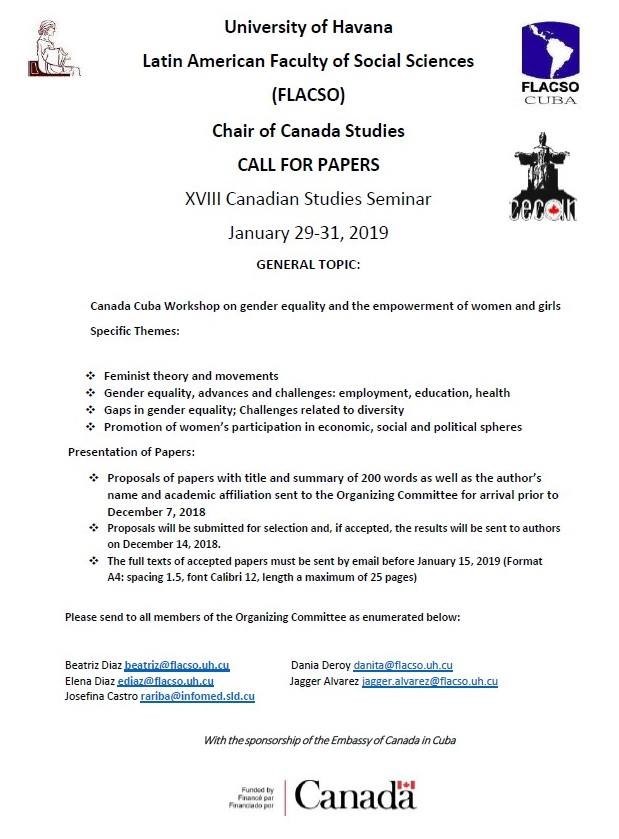
Submission deadline: January 15, 2019.
Unceded xʷməθkʷəy̓əm (Musqueam) Territory, University of British Columbia, Vancouver, 3-5 June 2019
The Indigenous Literary Studies Association invites scholars, knowledge-keepers, writers, artists, and community members to reconsider dominant discourses of reconciliation through explorations of Indigenous literatures as literatures of truth, reformation, reclamation, resurgence, and redress. This conference seeks to animate “redress” as the missing word between truth and reconciliation in Canada. Without redress, reconciliation will remain a vague, imagined ideal of a happy, inclusive country where “sharing” means that nothing changes for either Indigenous peoples or non-Indigenous Canadians. We are at a moment in time when talk about reconciliation proliferates while truth continues to go missing in numerous discursive arenas (corporations, governments, education systems). We suggest that between truth and reconciliation is a gap that can only be overcome by the restoration of and compensation for lands and resources stolen from Indigenous peoples. Beyond land and treaty rights, Indigenous sovereignty, languages, and kinship affiliations need to be restored. Indeed, some of the most vibrant invocations of Indigenous self-determination and calls to action come from our literary arts.
The Indigenous Literary Studies Association welcomes participants to consider truth, sovereignty, and redress in connection to Indigenous writings in their multiple and expansive dimensions, including discussions of literature, film, theatre, performance, storytelling, song, hip-hop, and other forms of narrative expression. We support diverse modes of creating and disseminating knowledge. Prospective participants are invited to propose conference papers, panels, roundtables, workshops, performances, and other formats for special sessions. Panel sessions will be 90 minutes in duration, including at least 15 minutes for questions and discussion. In keeping with our desire to enable dialogue and community-based learning, we welcome session proposals that utilize non-standard or alternative formats.
Submission deadline: Jan. 15, 2019.
The Inter national Journal of Canadian Studies is a bilingual, multidisciplinary, and peer-reviewed journal featuring the latest research in the field of Canadian Studies. Articles from IJCS have been cited more than 1,500 times and downloaded over 9,000 times in the last three years. The IJC Editorial board invites a broad range of topics and approaches in the study of Canada, including essays using comparative methods or multi-/interdisciplinary perspectives as well as proposals for special theme issues, based on conferences or with a Call for Papers.
Both the IJCS editors and editorial board welcome academics at any stage of their career, from Canada and beyond, to explore any aspect of the study of Canada. IJCS publishes full-length articles based on primary research. All submissions must undergo peer review and final decisions regarding publication are made by the Editorial Board. Visit http://bit.ly/IJCS_Submissions for more information regarding submissions to IJCS, including guidelines for submission.
The International Journal of Canadian Studies is available online at IJCS Online and Project MUSE.
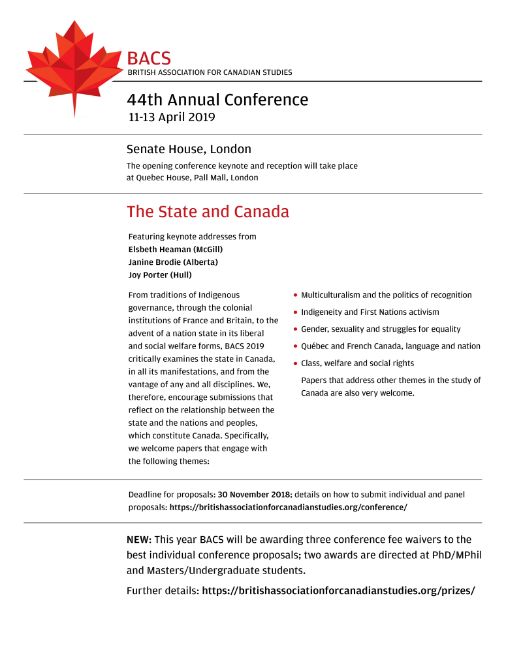 The next British Association for Canadian Studies Annual Conference will be taking place on 11-13 April 2019 in London, UK! The topic of the conference will be “The State and Canada.”
For the full call for papers and information how to apply, https://britishassociationforcanadianstudies.org/conference/.
Deadline: Nov. 30, 2018.
La Société bibliographique du Canada, Congrès des sciences humaines de Vancouver
Les 3 et 4 juin 2019, bibliographes et historiens du livre se réuniront au Congrès des Sciences Humaines tenu à Vancouver, Colombie-Britannique, afin d’étudier le rôle des textes comme vecteurs de conversations entre Canadiens de toutes les époques et d’examiner la mutation des formes du livre alors que celui-ci se décline à travers de multiples plateformes interactives et numériques.
Date limite: 30 novembre 2018.