
Skip to content
Kategorien
Aktuelles Veranstaltungen

Online lecture by PD Dr. Andrea Strutz (Institut für Geschichte, Universität Graz, Austria), “Music in Canada after the Second World War: About Limitations, Opportunities and the Significance of Refugees in a New Cultural Space.” 

December 16, 2021, 12 p.m

The Regionalism and Borderlands Research Group (RBRG) is pleased to invite you to the lecture by PD Dr. Andrea Strutz (Institut für Geschichte, Universität Graz, Austria), “Music in Canada after the Second World War: About Limitations, Opportunities and the Significance of Refugees in a New Cultural Space.”

The event continues the lecture series “Borders, Boundaries, Regions: Literary and Cultural Perspectives on Spaces,“ which is organized by the Regionalism and Borderlands Research Group (RBRG) at the Institute of Literature and New Media. The main aim of the series is to gain new perspectives on the concepts of regionalism and borderlands in an interdisciplinary discussion between international scholars.
Kategorien
Aktuelles Veranstaltungen

Conférence en ligne du professeur Daniel Chartier (UQAM) : « Qu’est-ce que l’imaginaire du Nord? Principes éthiques »

Date : 14 décembre, 16h30 – 18h00

L’Institut d’études romanes de l’Université de Varsovie organise, en collaboration avec l’AIEQ, une conférence du professeur Daniel Chartier (UQAM) intitulée « Qu’est-ce que l’imaginaire du Nord? Principes éthiques » .

Le Nord est un espace imaginé et représenté depuis des siècles par les artistes et les écrivains du monde occidental, ce qui a mené, au fil du temps et de l’accumulation successive de couches de discours, à la création d’un « imaginaire du Nord » – que ce Nord soit celui de la Scandinavie, du Groenland, de la Russie ou du Grand Nord, ou encore des pôles. Or les Occidentaux ont atteint le Pôle Nord il n’y a qu’un siècle, ce qui fait du « Nord » le produit d’un double regard, de l’extérieur – les représentations, surtout occidentales – et de l’intérieur – les cultures nordiques (inuites, scandinaves, cries, etc.). Les premières étant souvent simplifiées et les secondes méconnues, si l’on souhaite étudier le « Nord » dans une perspective d’ensemble, nous devons donc poser deux questions : comment définir le Nord par l’imaginaire ? Selon quels principes éthiques devons-nous considérer les cultures nordiques pour en avoir une vue complète, incluant notamment celles qui ont été minorées par le Sud ? Nous répondrons ici à ces deux questions, d’abord en définissant l’imaginaire du Nord, puis en proposant un programme intégrateur pour « recomplexifier » l’Arctique culturel.

Kategorien
Aktuelles Veranstaltungen

Zoom event: Angie Abdour reads from _This one Life: A Mother-Daughter Wilderness Memoir_

Reading Mountains 2021

December 13, 7 pm CET, Zoom

“This memoir about a mother and daughter forging connections with the wilderness – and each other – is like going forest bathing: it will leave you feeling refreshed and restored, with a big smile on your face.”

– Marni Jackson, author of The Mother Zone

This One Wild Life – A Mother-Daughter Wilderness Memoir

Disillusioned with overly competitive organized sports and concerned about her lively daughter’s growing shyness, author and memoirist Angie Abdou takes on her next challenge: to hike a peak a week with Katie. They will bond in nature and discover together the glories of outdoor activity. What could go wrong? Well, among other things, it turns out that Angie loves hiking but Katie doesn’t.

About the Author

Angie Abdou is the author of five novels and a memoir of hockey parenting, Home Ice. Her first novel, The Bone Cage, was a CBC Canada Reads finalist and was awarded the 2011-12 MacEwan Book of the Year. Angie is Associate Professor of Creative Writing at Athabasca University. She lives in Fernie, B.C., with her family and two beloved but unruly dogs.  

Kategorien
Aktuelles Veranstaltungen

Jutta Zimmermann: Setting Boundaries: Narrative Juxtaposition and the Negotiation of Identity in Contemporary Global Novels (online)

December 2, noon, on MS Teams: https://bit.ly/LIT_BBR_1

Many contemporary novels (and films, graphic narratives, TV series) consist of more than one story. In such novels, various settings, characters, and time periods are set against each each other by an act of juxtaposition. The boundary between the local narratives is usually marked by gaps, asterisks or other paratextual markers, and its existence sets in motion a process by which readers need to make sense of the disruption performed in order to assess the meaning of the overall global narrative. The marked boundary initiates a process in which the distinct narrative units which are related to each other, a process in which parallels and contrasts come to fore. While this process to a certain degree works towards integration, it also foregrounds the fragmentation and heterogeneity of the overall text. In my talk, I will explore the affinity of such multi-narrative texts to a particular thematic preoccupation, namely that of representing identities constituted by the straddling of cultural borders in post-colonial contexts. By looking at individual test cases – such as Dionne Brand’s What We All Long For – I will discuss whether multi-narrative structures can be viewed as the ‘discursive articulation’ of a ‘universal humanism’ or to what extent they are used for the ‘opposite effect’, namely ‘fragmentation and division rather than unity” (Tiago de Luca).

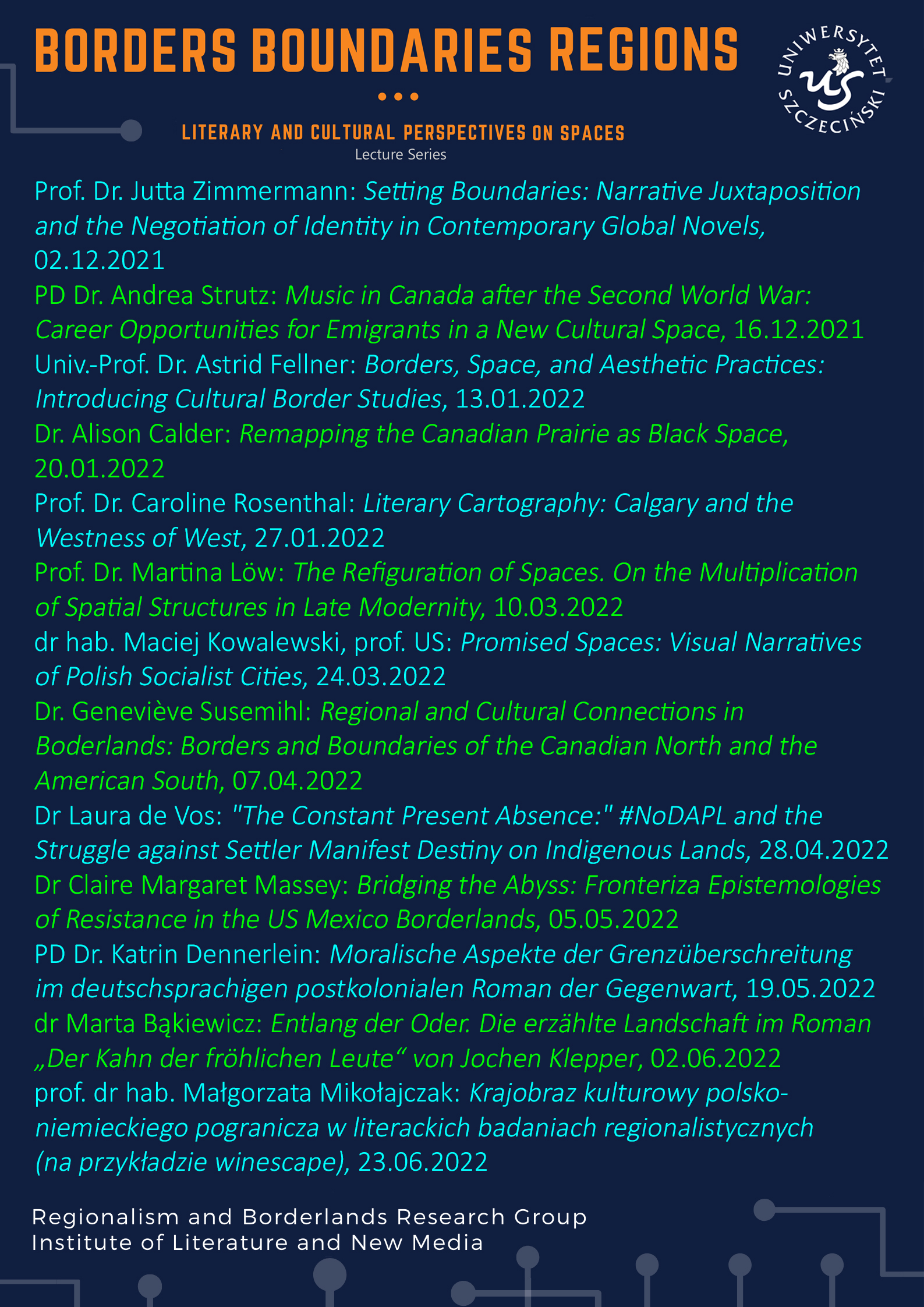
The talk is part of a lecture series on Borders/Boundaries/Regions: Literary and Cultural  Perspectives on Space at the University of Szczecin (Programme below):

Kategorien
Aktuelles Veranstaltungen

Glen Coulthard: Once We Were Maoists: Third World Currents in Fourth World Anti-Colonialism (Zoom)

You are warmly invited to an online-talk by Glen Coulthard (Yellowknives Dene), Associate Professor at UBC.

The talk takes place online (Zoom) on December 15, 2021, 5 pm European Central Time. Tickets can be ordered here:

Eventbrite<https://www.eventbrite.com/e/glen-coulthard-presents-once-were-maoists-fourth-world-anti-colonialism-tickets-217539706117>

This presentation will provide a history of Red Power radicalization and Indigenous-Marxist cross-fertilization. It examines the political work undertaken by a small but dedicated cadre of Native organizers going by the name Native Alliance for Red Power (or NARP) in Vancouver, British Columbia (BC), from 1967 to the 1975. It argues that their political organizing and theory-building borrowed substantively and productively from a Third World-adapted Marxism which provided an appealing international language of political contestation that they not only inherited but sought to radically transform through a critical engagement with their own cultural traditions and land-based struggles. Not unlike many radicalized communities of color during this period, NARP molded and adapted the insights they gleaned from Third World Marxism abroad into their own critiques of racial capitalism, patriarchy, and internal colonialism at home.