Skip to content
Kategorien
Aktuelles Call for Papers Veranstaltungen

Symposium: Indigenizing Psychology: Healing & Education

The Sixth Annual OISE Indigenous Education Network Mental Health Symposium, 26 May 2016, Native Canadian Centre of Toronto, Canada

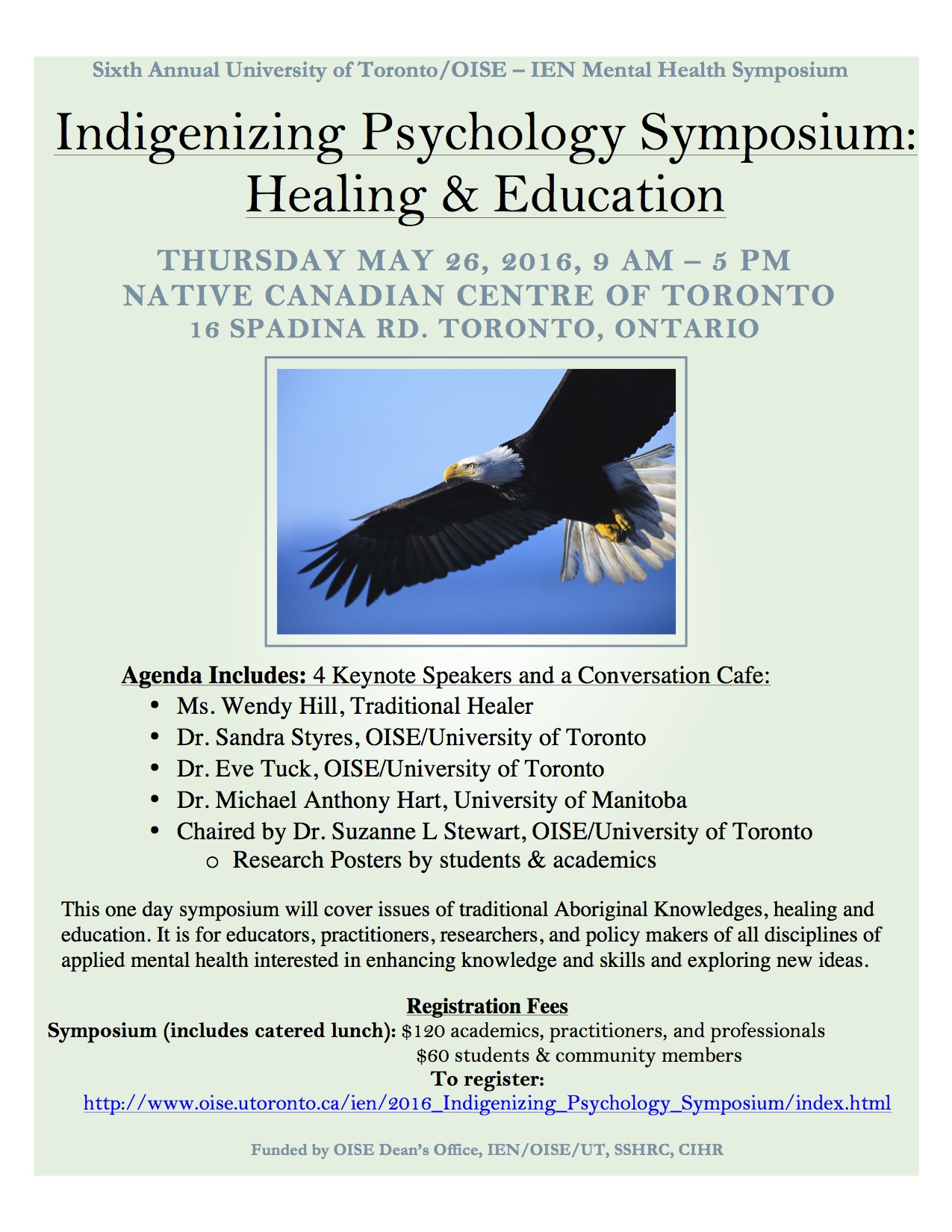
IEN_Symposium_Poster_2016_copyThe overarching goal of this Symposium is to build on our previous and current conceptions of Indigenous psychology and to provide new and innovative information, inquiry, and synthesis of mental health issues and solutions from Aboriginal knowledges. Through the development of new insights regarding Indigenous psychology throughout the Symposium, cutting edge and creative theories and models for addressing current mental health needs, including programming, counseling, and assessments of Indigenous peoples in Canada. This year’s symposium has a special focus on Healing and Education, taking a lead on discussing and strategizing implementation of the Truth and Reconciliation Commission’s Final Report’s recommendations.

This Symposium will achieve several general central objectives. First, to get a clear understanding of the psychology of Indigenous mental health and healing by articulating conceptual foundations that expand the current deficit model of mental health, enriching knowledge by focusing on the social processes of socio-political contexts, culture, and traditional knowledges and medicines and how these are linked to psychology. Secondly, to bring together leaders and innovators in the fields of Indigenous mental health from traditional, academic, and practitioner backgrounds. The sharing of ideas and ensuing dialogue of the diverse expertise of these high profile speakers will allow all attendees at the Symposium to take part in the creation of Indigenous healing solutions to psychological challenges that will be developed out of the strengths and resources that Indigenous individuals and communities provide to explain the key intersections of mental health, socio-political realities, and Aboriginal knowledges. Thirdly, The Annual Indigenous Education Network Mental Health Symposium was developed in 2010 by Dr. Suzanne Stewart to address a dire need for the advancement of the psychology of Indigenous mental health from Aboriginal knowledges, given the overwhelming lack of culturally based theory and models and the growing population of Indigenous peoples migrating to cities, many of whom seek fruitless mental health services from non-Indigenous perspectives.

More specific Symposium objectives include:

  • Reaching a diverse audience of those interested in Indigenous mental health, including educators, researchers, academics, students, practitioners, policy makers, and community service administrators.
  • Developing new and refining existing traditional Aboriginal approaches to current mental health issues.
  • Engaging Indigenous and non-Indigenous individuals and communities in meaningful dialogue on Indigenous mental health and healing.
  • Training and/or enhancing the careers of Aboriginal scholars, practitioners, policy makers, and administrators.
  • Infusing Aboriginal ways of knowing into current applied psychology theories and practices.
  • Preserving and documenting Aboriginal knowledges within the various levels of research, practice, and administration.
  • Identifying knowledge mobilization tools to extend research and practice impact to Indigenous communities first, and then more broadly to non-Indigenous contexts.
  • Considering diverse modalities for Indigenous psychology: e.g. traditional Indigenous, academic, Western, Eastern, African, hybrid, etc.

Specifically, the symposium will explore six key topic areas via oral presentations, workshops presentations, and cultural workshops by leading Canadian Indigenous health and healing practitioners. As well, we invite researcher, student, institutional, and community organization members to present posters within the following topics:

  1. Indigenous counselling and psychotherapy theory and practice
  2. Psychological assessment from Indigenous perspectives
  3. Integration of Indigenous and Western healing in mental health
  4. Traditional cultural healing in mental health service
  5. Research and ethical issues
  6. Policy, program, and administrative issues

You may submit abstracts for poster presentations in any of the above key topic areas until May 15, 2016. Please email name, title, and abstracts to this address.

For more information or to register please contact the Conference Committee.

Tickets are available here.

Registration fees:
$120 for academics, practitioners and professionals
$60 for students & community members

For registration, please visit the Conference Website.

Kategorien
Aktuelles Call for Papers Veranstaltungen

CfP: The Toronto School: Then – Now – Next

International Conference, October 14 – 16, 2016, Toronto (ON), Canada

Between the 1930s and the 1970s, a community of intellectuals coalesced in the city of Toronto to discuss and investigate communication as a complex, interdisciplinary process that structures individuals, cultures, and societies. This scholarly community, that emerged in and around the University of Toronto achieved international recognition for its innovative and trans-disciplinary approaches to the evolving societal challenges.

„The Toronto School: Then – Now – Next“-Conference aims to bring together international scholars to engage in dialogue on the origins, rise, decline and the rebirth of the so-called Toronto School. Discussion will focus on its pioneers, champions but also its critics. It will examine the extent to which the Toronto School has provided a legacy that continues to offer insight on crucial and systemic issues facing contemporary society across various disciplines.

General areas of interest include, but are not limited to, the following topics:

  • New understandings, approaches, comparative assessments of the major figures associated with the golden age of the Toronto School, including for instance Eric Havelock, Harold Innis, Marshall McLuhan, Northrop Frye, Edmund Carpenter, Walter J. Ong, Tom Easterbrook, Jaqueline Tyrwhitt, Carl Williams, Glenn Gould, and Harley Parker
  • Innovative interpretations of theories in their historical context, and ideas emanating from the School and its intellecutal tradition
  • Associations between core theories/ideas of the Toronto School of Communication and other schools/traditions, in the Humanities, in the Social Sciences and contemporary culture
  • Germination of media studies in 1950s Toronto
  • Canadian approaches to communications study and their impact on the twentieth-century intellectual debate internationally
  • Role of communication in the history of civilization, and in the structuring of human cultures and the mind
  • Time-biased and space-biased dialectical approaches applied to cultural ecology
  • Sensorial, cognitive, and behavioural implications of the medium
  • Interplay of orality and literary in today’s media environment
  • Poetic, symbolic, and mythical thinking in contemporary cultures
  • Aesthetic forms as a mode of critique and interpretation of cultural artifacts
  • Interpretation, extension, and application of the theories central to thinkers from the Toronto School

Authors are invited to submit their abstracts by June 30, 2016, using exclusively EasyChair.

Abstracts of between 1.000 and 1.500 words, in English, and presented in pdf format should be uploaded into EasyChair along with: title of proposed presentation, five keywords, and for each author their name, title, position, name afffiliated institution and a short biographical statement (40 – 50 words each). In addition details for the corresponding author should be provided.

In case of acceptance, author(s) will be asked also to provide a condenses abstract (200 words for inclusion in the program), and to present the paper at the Conference (see registration deadline for authros).

A condensed abstract of each paper and a biographical statement of presenting author(s) will be published in the Conference Program.

All submissions will be reviewed by the Program Committee.

For more information, please have a look here.

Kategorien
Aktuelles Ausschreibungen Call for Papers Veranstaltungen

CfP: Mid-Atlantic New England Council for Canadian Studies Biennial Conference

Mid-Atlantic New England Council for Canadian Studies Biennial Conference
Portland Regency Hotel and Spa, Portland, ME/USA, October 20-22, 2016

The Mid-Atlantic-New England Council for Canadian Studies (MANECCS) is currently accepting papers from all academic disciplines for the 35th Anniversary Conference to be held at the Portland Regency Hotel and Spa in Portland, Maine between October 20 and 22, 2016.  https://maneccs2016.wordpress.com/.

MANECCS is the premier Canadian Studies organization in the region and is affiliated with the Association for Canadian Studies in the United States (ACSUS). Over the past 35 years MANECCS has brought together scholars from across the academic disciplines and from both public and private sectors in education, business, and government. At these conferences scholars explore complex topics relevant to Canada and its position in the world; past, present, and future. The organizers have an exciting biennial conference planned for their 35th anniversary year.

This year will seek to focus specifically on urban and industrial landscapes. The organizers are especially interested in panels that deal with urbanization, sprawl, decline, reattribution, urban and industrial living and working places, urban recreation and social organization, crime and policing, and any other topic related to Canada’s industrialization and urbanization. *Proposals on other topics related to Canadian history and studies are welcome.*  Papers from established scholars, emerging scholars, and graduate students are encouraged.

Please submit a 250-word paper proposal or a 500-word panel proposal no later than June 1, 2016 to Brian Payne, Associate Professor History, Bridgewater State University (email). Please keep apprised of all developments at: https://maneccs2016.wordpress.com/.

Kategorien
Aktuelles Ausschreibungen Call for Papers Veranstaltungen

CfP: „Literature and the Environment“

International Conference, June 8 – 10, 2017, University of Graz (Austria)

The aim of this conference is to underline the specific relevance of literature and of literary studies for environmental and ecological concerns. As literature has addressed environmental issues in the past decades, and eco-literature has evolved into a disctinctive new genre, eco-criticism has emerged as a concomitant branch of literary studies. However, there still seems to be a tendency within literary criticism to regard eco-literature as a form of littérature engagée which is rather less satisfactory from an aesthetic point of view. This view has often led to an almost exclusive focus on contents in critical approaches to committed environmental literature. However, and as suggested by Hubert Zapf’s model of literature as an element of a cultural ecology, it is the specifity of literary texts which determines, to a large extent, their unique cultural function. Thus, literature unfolds its main potential with regard to cultural transformations not only on a thematic or referential level, but also as an effect of „the specific structures and functions of literary textuality as it has evolved in relation to and competition with other forms of textuality in the course of cultural evolution“ (Zapf 2006).

The conference thus aims at exploring the potential of literary texts as cultural manifestations which either operate apart from or undermine pragmatic, one-dimensional and conventionalized discourses of ‚innovation‘ and ‚development‘. The organizers invite papers which discuss individual works or genres with a view to the textual strategies they employ in order to position themselves within the larger system of discourses that define our relationship with the environment.

Papers may want to address the following:

  • Literary renderings of environmental crisis
  • Poetic/dramatic/narrative strategies for mediating environmental issues
  • Human/non-human agency in literary texts
  • Constructing and envisioning animals and animal perspectives
  • Intertextuality, parody etc. as counter-discursive strategies
  • Negotiating the pragmatic and the aesthetic in environmental literature
  • Genre and the question of environmental issues

Length of paper presentations: 20 minutes

Please send your proposal (ca. 250 words) to this email address.

Deadline: 30 September 2016.

Kategorien
Aktuelles Ausschreibungen Call for Papers

CfP: History, Memory, and Generations: German-Canadian Experiences From the Eighteenth to the Twenty-First Centuries

Much of Canadian immigration historiography has focused on the first generation immigrants, including two important collections on German immigrants in Canada published in 1998 and 2012. While scholars have increasingly looked at the 1.5 and second generations, they have tended to conceptualize them as distinct categories or generations.

This proposed collection of articles, focusing on the experiences, histories, and memories of German immigrants in Canada and their descendants, seeks to explore how multi-generational families and groups have interacted and shaped each other’s integration and adaption in Canadian society. As one of Canada’s oldest and largest ethnic groups, German-Canadians allow for a variety of longitudinal and multi-generational studies that explore how different generations have negotiated and transmitted diverse individual and group experiences in the form of memories and histories.

Having come from places and times of conflict and war, such as two world wars as well as conflicts in North America, the volume of essays focuses on intergenerational experiences, memories, and histories of war, flight, displacement, and resettlement. This will allow scholars of German-Canadian history to connect their studies in fruitful ways with recent research in memory and refugee studies.

Following in the path of two previous successful collections in German-Canadian History, A Chorus of Different Voices: German-Canadian Identities (eds. Angelika Sauer and Matthias Zimmer) and Beyond the Nation? Immigrants‘ Local Lives in Transnational Cultures (ed. Alexander Freund), this collection seeks to engage the newest scholarship on generation, memory, and migration to illuminate how German-Canadians have lived in Canadian societies over the past 300 years.

More broadly, this collections seeks to document the state of the art in German-Canadian History, and thus proposals for essays on all topics in the field are invited.

The University of Manitoba Press has expressed an interest in reviewing the collection for potential publication in its Studies in Immigration and Culture series.


Timeline:

  • 30 April 2016: 500 word abstract and short bio
  • 15 June 2016: invitations to submit essays
  • 30 October 2016: 6,000 word essay (including footnotes, no bibliography or list of references; Chicago style)
  • 31 January 2017: final acceptance/rejection, first round of revisions
  • 31 March 2017: final revisions
  • 30 April 2017: submission of manuscript to university press

For more information or questions on the project, please contact:

Dr. Alexander Freund
Chair in German-Canadian Studies
Professor of History
Co-director, Oral History Centre
The University of Winnipeg
515 Portage Avenue
Winnipeg, MB
Canada R3B 2E9
Email.